The water vessel
The first vessel was a coconut shell, which gave the narghile its name.12
The Amsterdam Pipe Museum holds a Yemeni water pipe of coconut and brass from 1860-1920. So the coconut did not disappear with the first hookahs.3
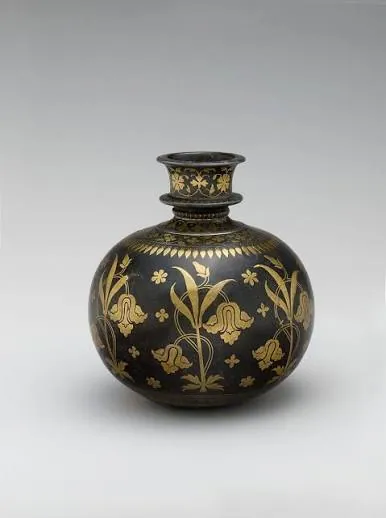
In the Indian city of Bidar the vessel becomes an art object of zinc alloy with brass inlay. Such a vessel from the late 17th century in the Metropolitan Museum is only 17.5 cm tall.45
The glass vessel gives the name shisha, from Persian šīša, glass. Lane describes it in Egypt in 1836.67
The bowl
The Science Museum in London holds an earthenware hookah bowl from the 19th century, from the Arabian Peninsula or the Middle East: funnel-shaped, with a shallow well and holes in the bottom, painted in blue.8
Mu'assel gave the bowl a new problem: molasses juice runs down the holes into the stem. A 2016 patent application cites the Tangiers Phunnel and the Sahara Smoke Vortex as examples of bowls designed to keep the juice up top.9
The heat management device from Kaloud's patent replaces the foil with a plate that rests on the bowl.10
Hose and mouthpiece
From the start the hookah was a thing for company, so the hose and mouthpiece are shared. In venues each guest usually gets a disposable mouth tip, but the hose, bowl and other parts are reused.11
That is why in 2020 the WHO warned that sharing mouthpieces and hoses could spread the coronavirus.14
The electronic hookah
Patent US 9,095,174, "Electronic hookah", describes a hookah in which the tobacco is replaced by an electronic device that produces vapour, with several people able to smoke at once. The application was published in 2013.12
On the journey through 14 stations
How we know
- 1Merriam-Webster, "narghile"
- 2Science Museum Group, "Nargileh or gozeh pipe"
- 3Amsterdam Pipe Museum, APM 22.287
- 4The Met, "Base for a Water Pipe (Huqqa) with Irises", 1984.221
- 5The Met, Heilbrunn Timeline: 1984.221
- 6Edward W. Lane, "Manners and Customs of the Modern Egyptians" (1836)
- 7Wiktionary, "shisha"
- 8Science Museum Group, "Hookah tobacco pipe bowl (Arabian or Middle Eastern)", A653362
- 9US 2016/0037825 A1, "Hookah bowl with single use insert" (Justia Patents)
- 10Google Patents, US9237770B2 "Hookah heat management accessory"
- 11BMJ Tobacco Control blog (2020), "Waterpipe Tobacco Smoking: A Potential Conduit of COVID-19"
- 12Google Patents, US9095174B2 "Electronic hookah" (US 2013/0032159)
- 13Salar Jung Museum, "Romance of the Huqqa" (Google Arts & Culture)
- 14Arab News (2020), "Has coronavirus killed off shisha cafes forever?"