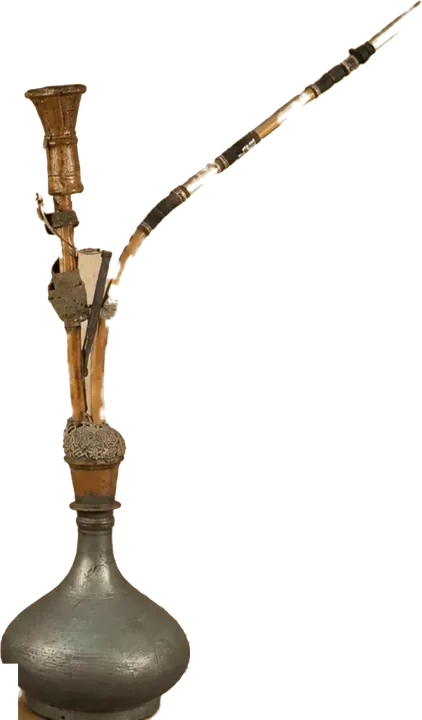
Hookah history

The evolution of the hookah

From a coconut shell at the Persian court to a shisha bar in Berlin. Follow the smoke trail through five centuries and fourteen cities.

Start the journey

Engraved brass
old formEngraved brass
Then
Now

Parts of a hookah

Bowl
Holds the tobacco, with coals or a heat device on top.
Grommets
Seal the joints so air only flows through the tobacco.
Tray
Catches ash and holds spare coals.
Stem
Carries smoke from the bowl to the water and holds the hose port.
Hose
Draws the smoke out of the vase.
Mouthpiece
The end of the hose that goes to the lips.
Diffuser
Breaks up bubbles in the water so the hookah runs quieter.
Vase
The water cools the smoke. It cools it, but does not clean it.

The smoke trail

Fourteen stops, five centuries

The camera flies to every city where the hookah changed. The map changes with the years: an old chart, a printed map, then a city at night. Small numbers lead to the sources at the bottom.

Buttons, arrow keys, swipe, or click a pin on the map.

  1. Stop 1 of 14

    Persia (Safavids) · Isfahan

    The first reliable traces

    Illustration: Persian qalyan

    Local name qalyan

    • Tobacco was reportedly brought to Persia by the Portuguese in the early 16th century.3
    • The poet Ahli Shirazi (d. 1535) mentions the qalyan, but Encyclopaedia Iranica notes there is no evidence of the water pipe before the 1560s. Something else may have been smoked.2
    • Shah Abbas I (r. 1588-1629) disliked tobacco and banned it, yet people kept using it.3
  2. Stop 2 of 14

    India (Mughals) · Agra and Fatehpur Sikri

    Tobacco reaches Emperor Akbar's court

    Illustration: huqqa with a long hose

    Local name huqqa

    • Asad Beg, Akbar's envoy to Bijapur, returned in 1604 with tobacco and a jewelled pipe and offered them to the emperor.1
    • Tradition says the court physician Abul-Fath Gilani came up with "purifying" the smoke through water. It is a story, not a document.12
    • The word hookah comes via Hindustani huqqa from the Arabic ḥuqqa, the vessel of a water pipe.6
  3. Stop 3 of 14

    Ottoman Empire · Istanbul

    A fire, coffeehouses and the death penalty

    Illustration: narghile with a glass vase

    Local name nargile

    • According to historian Refik Ahmet Sevengil, tobacco reached Istanbul around 1600.12
    • In 1633 a great fire in the Cibali quarter, started by a man who fell asleep with his pipe on a boat, destroyed more than 20,000 homes.9
    • Sultan Murad IV closes the coffeehouses and introduces the death penalty for smoking tobacco in public.910
  4. Stop 4 of 14

    India (Deccan) · Bidar

    Bidri: the hookah as art

    Illustration: bidri huqqa base

    Local name huqqa

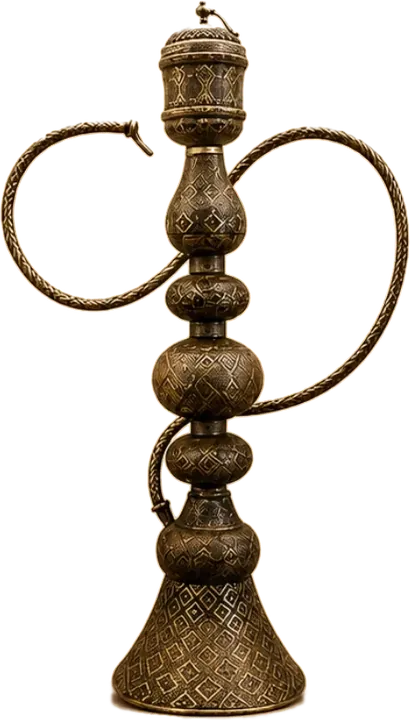
    • In the city of Bidar, huqqa bases were made of zinc alloy, engraved and inlaid with brass. The technique is named bidri after the city.7
    • The Metropolitan Museum in New York holds such a base with irises from the late 17th century (acc. no. 1984.221).7
    • Early Bidar bases are almost always spherical; only one or two ovoid examples are known.8
  5. Stop 5 of 14

    Egypt · Cairo, Khan el-Khalili

    A café open for over two centuries

    Illustration: glass shisha

    Local name shisha

    • El Fishawy café in the Khan el-Khalili bazaar opened in 1771 or 1797, depending on the source, and has been run by the same family for generations.202119
    • Nobel laureate Naguib Mahfouz was a regular and wrote parts of his famous trilogy there.2021
    • In 1836 Edward Lane records that wealthier Egyptians smoke the "nargila", because its water vessel is a coconut, while the glass version is called "shisha".18
  6. Stop 6 of 14

    Yemen · Sana'a

    Coconut and brass

    Illustration: coconut water pipe
    • The Amsterdam Pipe Museum holds a coconut-and-brass water pipe from 1860-1920, which experts describe as Yemenite.15
    • The British Museum also holds Yemeni water pipes from the 1970s.16
    • The word narghile comes from Persian nārgīl, coconut, because the first water vessel was a coconut shell.5
  7. Stop 7 of 14

    Persia (Qajars) · Tehran

    The boycott that beat the shah

    Illustration: Persian qalyan

    Local name qalyan

    • In March 1890 Shah Naser al-Din grants the Briton G. F. Talbot a monopoly on tobacco production, sale and export for 50 years.13
    • More than 200,000 people in Persia then made a living from tobacco.13
    • In December 1891 Mirza Hasan Shirazi issues a fatwa against using tobacco and the boycott spreads across the country. The concession is cancelled in January 1892.1314
  8. Stop 8 of 14

    Lebanon · Beirut and Tripoli

    Argileh and café talk

    Illustration: glass shisha

    Local name argileh

    • Research at the American University of Beirut describes the Beirut café of the 1950s to 1980s as a place where the city's cultural life was made.25
    • In Tripoli, Café Fahim, one of the oldest surviving cafés in the country, still has older men smoking argileh for hours.24
  9. Stop 9 of 14

    Egypt · Cairo

    Mu'assel: flavoured tobacco

    Illustration: Egyptian shisha

    Local name shisha

    • Mu'assel means "honeyed". It is tobacco mixed with molasses, glycerine and fruit flavours.22
    • By the late 20th century the hookah in the Middle East was mostly smoked by older men in cafés. From the early 1990s mild mu'assel draws in the young.2247
    • Some sources trace mu'assel to early 20th century Egypt, but the exact start is unknown.22
  10. Stop 10 of 14

    USA · Southern California

    The hookah lounge next to campus

    Illustration: modern hookah

    Local name hookah

    • Between 1999 and 2004, 200 to 300 new waterpipe cafés opened in the USA, mostly in college towns.27
    • At one large university, 9.5% of students had smoked a hookah in the past 30 days (2008 study).27
    • California's Starbuzz presents itself in a registered trademark as "Starbuzz Tobacco since 2005".28
  11. Stop 11 of 14

    United Arab Emirates

    Fruit shisha becomes big business

    Illustration: Egyptian shisha

    Local name shisha

    • In 2006 Jordan's Al Eqbal Investment Company bought the Al Fakher factory in the Emirates for 11 million dollars.26
    • After the purchase the factory was automated, and the brand sells in more than 100 countries.26
    • In November 2020 the British fund Kingsway Capital took over Al Eqbal (owner of Al Fakher) in a deal valued at more than 1.4 billion dollars.4346
  12. Stop 12 of 14

    Bosnia and Herzegovina · Sarajevo

    Back to Baščaršija

    Illustration: narghile with a glass vase

    Local name nargila

    • Baščaršija dates to 1462, when the Ottoman governor Isa-beg Ishaković built a caravanserai. It was the city's main artery for trade and social life.29
    • Sarajevo's tourist board writes that the nargila is very popular again after a pause of a few decades, especially in Baščaršija.30
  13. Stop 13 of 14

    Russia · Moscow

    A ban and fruit mixes

    Illustration: modern hookah

    Local name kalyan

    • In 2013 Russia passes a law against smoking in public places. Restaurants, cafés and hotels get until 1 June 2014.32
    • According to an estimate by RestConsult, hookahs were then offered in about 40% of Moscow eateries.31
  14. Stop 14 of 14

    Germany · Berlin

    The land of shisha bars

    Illustration: modern hookah

    Local name Shisha

    • There is no official count: ZDF reported more than 6,000 shisha bars in 2020, and the manufacturers' association estimated about 5,000 in 2024.3334
    • According to the Robert Koch Institute study (KiGGS, 2009-2012), 28.9% of teenagers aged 12 to 17 had tried a hookah, and about one in ten had smoked one in the previous 30 days.35
    • Because of carbon monoxide poisonings, Baden-Württemberg requires shisha venues to have proper ventilation and CO detectors.3938

Today

One smoke, the whole world

56,900 kmthat is how far the smoke travelled on this map, through 14 stops and 462 years

From Isfahan to Berlin the hookah changed its vessel, its name and its tobacco. Every trail on the map is one stop of that story.

Continue

The whole story

The history of the hookah in 8 chapters

For those who want more than the journey: each chapter is its own page to read, with sources at the end.

  1. c. 1320-1604Origins: where the hookah comes fromArchaeology, the legend of a court physician and a word for coconut. What is known about the beginnings, and what is just a good story.2 min read · 9 sources
  2. 1554-todayThe coffeehouse: home of the hookahFrom Tahtakale in Istanbul, through Bentbaša and Khan el-Khalili, to American lounge bars. The hookah lives where people sit and talk.2 min read · 13 sources
  3. 16th c.-todayTobacco: from tumbak to fruit blendsThe biggest change in hookah history was not in the glass or the metal, but in what goes into the bowl.2 min read · 12 sources
  4. coal, foil, electricityHeat: from glowing coal to electricityA hookah without heat is just a vase. How the tobacco was heated changed the taste, the gear and the health risks.2 min read · 12 sources
  5. coconut, metal, glass, steelParts: vessel, bowl, hoseEvery part of the hookah has its own small history. Some we can follow through museum collections, the newer ones through patents.2 min read · 14 sources
  6. 16th c.-todayThe hookah in Bosnia and HerzegovinaA coffeehouse at Bentbaša, Herzegovinian tobacco, Sarajevo's pipe makers and the hookah's return to Baščaršija.2 min read · 7 sources
  7. 1633-2022Laws and bansFrom a sultan's death penalty to ventilation rules. For four centuries rulers have tried to put out the coal, and the hookah keeps coming back.2 min read · 19 sources
  8. today and tomorrowThe hookah todayWho smokes the hookah today, what the industry is worth and what science says about the new devices.2 min read · 11 sources

Permanent exhibition9 exhibits

The hookah museum

From engraved brass to crystal and steel. Open a display case and look at each piece up close.

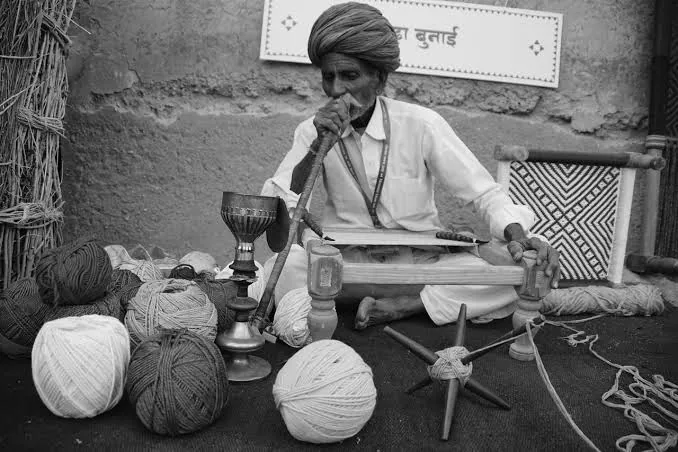
Black and white photo: an older man in a turban smokes a water pipe while weaving.
The hookah was never just tobacco. It was always a reason to sit down and talk.Image: MyShishapedia

Images and editing: MyShishapedia. These are illustrations, not dated museum objects.

Culture

The hookah in books and art

From Alice and the Caterpillar to Mughal miniatures and 19th century painters. The works are in museums, and the links lead to them.

Book

Alice's Adventures in Wonderland

Lewis Carroll

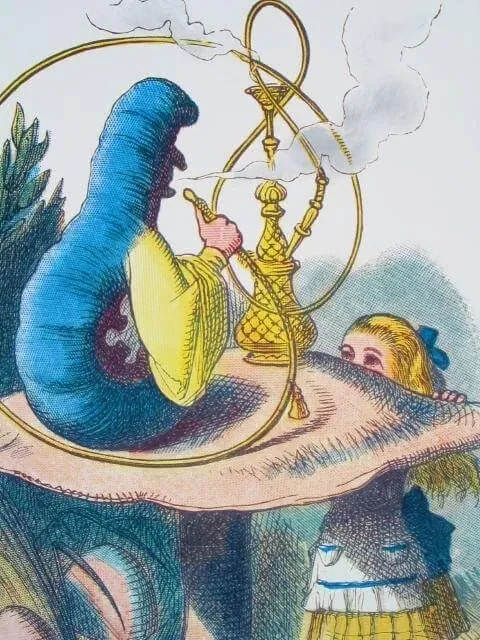
In chapter 5, "Advice from a Caterpillar", Alice finds a large blue caterpillar on top of a mushroom, quietly smoking a long hookah. The Caterpillar takes the hookah out of its mouth and asks her: "Who are YOU?"4849

Click the caterpillar

  • Miniature

    Nobleman Smoking on a Terrace

    attributed to Ali Reza

    A painting from around 1670 shows a nobleman in pink smoking from a long huqqa while a courtier holds its base. The style is closer to the Deccan than to the imperial Mughal court.50

    See the work
  • Portrait

    Emperor Shah Alam with a huqqa

    unknown painter

    The Victoria and Albert Museum in London holds a portrait of the Mughal Emperor Shah Alam sitting and smoking a huqqa.51

    See the work
  • Women of Algiers in their Apartment, Eugène Delacroix

    Painting

    Women of Algiers in their Apartment

    Eugène Delacroix

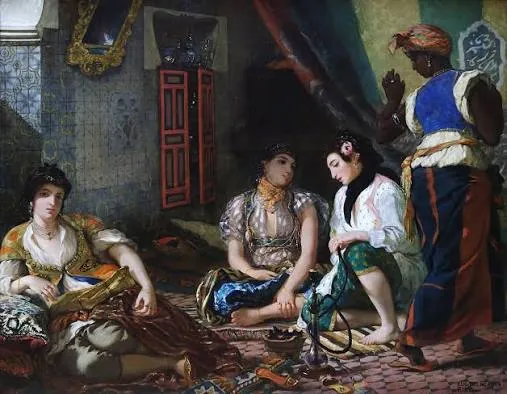
    Delacroix painted this work in 1834, and it is now in the Louvre. A narghile stands beside the women seated on the floor.53

    See the work
  • Bashi-Bazouk Singing, Jean-Léon Gérôme

    Painting

    Bashi-Bazouk Singing

    Jean-Léon Gérôme

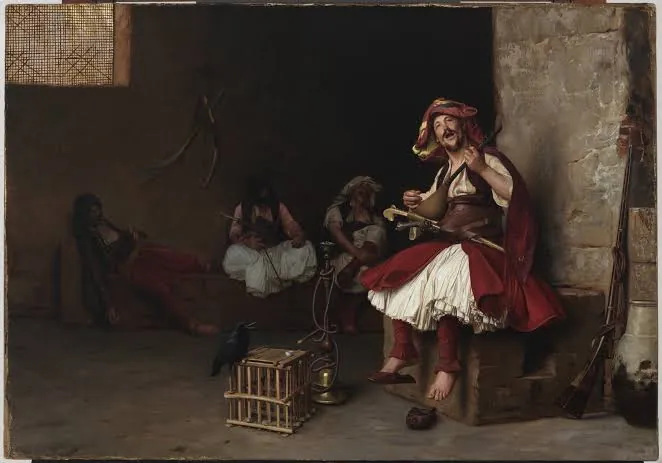
    In this 1868 painting an Albanian soldier sits by a hookah playing an oud, with a raven on its cage beside him. The painting is at the Walters Art Museum in Baltimore.52

    See the work
  • Writer

    The Nobel laureate of El Fishawy

    Naguib Mahfouz

    The Egyptian Nobel laureate was a regular at El Fishawy café in Cairo and wrote parts of his trilogy there.2021

    Go to the stop

People in the story

  • Asad Beg

    Emperor Akbar's envoy

    Brought tobacco and a jewelled pipe to the Mughal court, 1604.1

    Go to the stop
  • Shah Abbas I

    Safavid ruler

    Disliked tobacco and banned it, yet Persia kept smoking.3

    Go to the stop
  • Murad IV

    Ottoman sultan

    After the fire of 1633 he closed the coffeehouses and made public smoking punishable by death.910

    Go to the stop
  • Edward W. Lane

    British orientalist

    In 1836 described the Egyptian coconut narghile and the glass "shisha".18

    Go to the stop
  • Mirza Hasan Shirazi

    religious authority

    His fatwa of December 1891 launched a tobacco boycott across Persia.1314

    Go to the stop
  • Naguib Mahfouz

    writer, Nobel laureate

    A regular at El Fishawy, where he wrote parts of his trilogy.2021

    Go to the stop

Play

Test yourself and find your era

Quiz · 8 questions

The evolution of the hookah

Every answer is on this page. How much do you remember?

  1. 1. What does the Persian word nārgīl, which gave the narghile its name, mean?

    1. A) Coconut
    2. B) Glass
    3. C) Smoke
    Answer

    A) Coconut5

  2. 2. Where does the word shisha come from?

    1. A) From the Arabic word for honey
    2. B) From the Persian word for glass
    3. C) From the Turkish word for water
    Answer

    B) From the Persian word for glass42

  3. 3. Which sultan made public smoking punishable by death in 1633?

    1. A) Suleiman the Magnificent
    2. B) Mehmed II
    3. C) Murad IV
    Answer

    C) Murad IV910

  4. 4. What triggered the 1891 tobacco boycott in Persia?

    1. A) A tobacco monopoly granted to a Briton
    2. B) A new tax on coffee
    3. C) A ban on cafés
    Answer

    A) A tobacco monopoly granted to a Briton13

  5. 5. What does the word mu'assel mean?

    1. A) Smoky
    2. B) Honeyed
    3. C) Cold
    Answer

    B) Honeyed22

  6. 6. When does mu'assel bring the hookah back to young people in the Middle East?

    1. A) In the 1950s
    2. B) In the early 1990s
    3. C) In the 2010s
    Answer

    B) In the early 1990s2247

  7. 7. Which writer wrote parts of his trilogy at El Fishawy café?

    1. A) Naguib Mahfouz
    2. B) Orhan Pamuk
    3. C) Kahlil Gibran
    Answer

    A) Naguib Mahfouz2021

  8. 8. In which book does a caterpillar smoke a hookah?

    1. A) The Little Prince
    2. B) Alice's Adventures in Wonderland
    3. C) One Thousand and One Nights
    Answer

    B) Alice's Adventures in Wonderland4849

Test · 4 questions

Which era are you?

Four quick questions about your style, and at the end your stop in hookah history.

This test needs JavaScript.

Words

What it is called where

One thing, seven names. Each name keeps a piece of the story: a coconut, glass or a vessel.

  1. huqqa · hookah

    India, English

    From Arabic ḥuqqa, the vessel of a water pipe. In English since the 18th century.6

  2. qalyan

    Iran

    The Persian name, known since Safavid times.3

  3. nargila · nargile

    Turkey, the Balkans

    From Persian nārgīl, coconut, akin to Sanskrit nārikela.5

  4. shisha

    Egypt, the Gulf, Europe

    From Persian šīša, glass, via Turkish şişe, bottle.42

  5. argileh

    Lebanon, Syria

    The name used in the Levant, in cafés such as Café Fahim in Tripoli.24

  6. goza

    Egypt

    The Egyptian pipe with a coconut vessel; the Science Museum holds one from 1895-1900.17

  7. kalyan

    Russia

    Russian кальян, borrowed from Persian qalyan.44

Parts

How the parts evolved

Pick a step (or swipe) and see how one part changed over time.

The water vessel

The first water vessel was a coconut shell, which gave the narghile its name.517

In 17th century India the vessel becomes an art object of zinc alloy inlaid with brass.78

The glass vessel gives the name "shisha" (glass). Lane describes it in Egypt in 1836.1842

Coal and heat

The old "ajami" way: coals sit directly on soaked tobacco.24

Moist tobacco with molasses and glycerine needs gentler heat and changes how it is prepared.22

Kaloud's patent US 9,237,770 describes a plate that rests on the bowl and conducts the coal's heat to the tobacco, with a lid for regulation.41

Tobacco

In Safavid Persia, according to Chardin, Brazilian tobacco was especially prized for the qalyan.4

Strong leaf soaked and smoked plain, as it still is at Café Fahim.24

From the early 1990s fruit mu'assel becomes the most common hookah tobacco in the world.22

Fact check

Myth or truth

Read the claim, make a guess, then flip the card.

  • The water in a hookah removes all harmful substances.

    Myth

    Even after passing through water, the smoke contains high levels of toxic substances.40

  • The narghile is named after the coconut.

    True

    Persian nārgīl means coconut, and the first water vessel was a coconut shell.5

  • The hookah was invented by the physician Abul-Fath Gilani.

    Unsure

    That is tradition. Iranica gives his death as 1588, before tobacco reached Akbar's court in 1604.21

  • People once lost their heads for smoking.

    True

    In 1633 Murad IV introduced the death penalty for public smoking. The numbers executed are unreliable.910

  • Fruit-flavoured tobacco has been smoked for centuries.

    Myth

    Mu'assel only became popular in the early 1990s.2247

  • One hookah session equals one cigarette.

    Myth

    According to the WHO, one session can mean inhaling as much smoke as from 100 or more cigarettes.40

  • Shisha is an Arabic word.

    Unsure

    Partly: it is used in Arabic, but it comes from Persian šīša (glass), via Turkish.42

  • There is no carbon monoxide risk in a shisha bar.

    Myth

    A Düsseldorf clinic treated almost 40 hookah smokers for CO poisoning in a single year.38

Health

No sugar-coating

  • According to the WHO (2005), one hookah session can mean inhaling as much smoke as from 100 or more cigarettes.40
  • Water cools the smoke but does not clean it: even after the water, the smoke contains high levels of toxic substances.40
  • Burning coal produces carbon monoxide. After poisonings in shisha bars, some German states require ventilation and CO detectors.3839

Sources

How we know

Every claim on this page has a source. Where sources disagree, the text says so. The hookah and city illustrations are MyShishapedia drawings, not historical images.

  1. 1Salar Jung Museum, "Romance of the Huqqa" (Google Arts & Culture)
  2. 2Encyclopaedia Iranica, "Tobacco"
  3. 3Encyclopaedia Iranica, "Ḡalyān"
  4. 4Encyclopaedia Iranica, "Čopoq"
  5. 5Merriam-Webster, "narghile"
  6. 6Merriam-Webster, "hookah"
  7. 7The Met, "Base for a Water Pipe (Huqqa) with Irises", 1984.221
  8. 8The Met, Heilbrunn Timeline: 1984.221
  9. 9Daily Sabah, "Mighty sovereigns of Ottoman throne: Sultan Murad IV"
  10. 10Atlas Obscura, "In Istanbul, Drinking Coffee in Public Was Once Punishable by Death"
  11. 11Mental Floss, "7 Historical Bans on Smoking"
  12. 12Hürriyet Daily News, "Hitting a high the Ottoman way with tobacco"
  13. 13Wikipedia, "Tobacco Protest"
  14. 14Global Nonviolent Action Database, "Iranian resistance to Tobacco Concession, 1891-1892"
  15. 15Amsterdam Pipe Museum, APM 22.287
  16. 16British Museum, zbirka: vodene lule / collection: water-pipes
  17. 17Science Museum Group, "Nargileh or gozeh pipe"
  18. 18Edward W. Lane, "Manners and Customs of the Modern Egyptians" (1836)
  19. 19AramcoWorld (1996), "Fishawy's Café: Two Centuries of Tea"
  20. 20Cairo Governorate, "Cairo's Famous Coffeehouses"
  21. 21History Hit, "5 Historic Cafés to Visit in Cairo"
  22. 22Wikipedia, "Muʽassel"
  23. 23Moodie Davitt Report (2012), "Japan Tobacco to acquire leading Egyptian shisha manufacturer Nakhla"
  24. 24The National, "Coffee houses of the Middle East"
  25. 25AUB ScholarWorks, "The Beirut Coffeehouse and Café"
  26. 26Oxford Business Group (2014), "Al Eqbal Investment Company: Tobacco and cigarettes"
  27. 27Primack i sar. / et al. (2008), Annals of Behavioral Medicine (PMC3004534)
  28. 28USPTO via Justia, "STARBUZZ TOBACCO SINCE 2005"
  29. 29Visit Sarajevo, "Explore Baščaršija"
  30. 30Visit Sarajevo, "Days and nights"
  31. 31Bloomberg (2014), "Russia's Tobacco Ban Takes the Buzz Out of Hookah Bars"
  32. 32Deutsches Ärzteblatt (2013), "Putin unterzeichnet Anti-Tabak-Gesetz"
  33. 33ZDF (2020), "Shisha: Das gefährliche Geschäft mit dem kalten Rauch"
  34. 34Berliner Zeitung / dpa (2024), "Shisha-Branche befürchtet Pleitewelle"
  35. 35Robert Koch-Institut, "Smoke on the water: Wasserpfeifenkonsum bei Jugendlichen in Deutschland" (KiGGS Welle 1)
  36. 36KriPoZ (2022), "25-Gramm-Regelung im Vertrieb von Wasserpfeifentabak"
  37. 37Nordkurier / dpa (2024), "Erstmals seit 2019 wieder mehr Zigaretten versteuert"
  38. 38PTA heute (2018), "Lebensgefährliche Kohlenmonoxid-Vergiftungen durch Shisha-Rauchen"
  39. 39Baden-Württemberg, "Konsequenzen aus Kohlenmonoxid-Vergiftungen in Shisha-Bars"
  40. 40WHO (2005), "Advisory note: waterpipe tobacco smoking"
  41. 41Google Patents, US9237770B2 "Hookah heat management accessory"
  42. 42Wiktionary, "shisha"
  43. 43Slaughter and May (2020), "Kingsway Capital on the take-private of Al Eqbal Investment Company"
  44. 44Wiktionary, "кальян"
  45. 45Natural Earth (mapa / map data, javno vlasništvo / public domain), preko / via world-atlas
  46. 46Latham & Watkins (20. 11. 2020), "Latham advises on financing for Kingsway Capital take-private of Al Fakher"
  47. 47Rastam, Maziak i sar. / et al. (2004), BMC Public Health: waterpipe smoking in Syria (PMC514554)
  48. 48Lewis Carroll, "Alice's Adventures in Wonderland" (Project Gutenberg)
  49. 49Wikisource, "Alice's Adventures in Wonderland (1866)/Chapter 5"
  50. 50The Met, "Nobleman Smoking on a Terrace", pripisano / attributed to Ali Reza
  51. 51Victoria and Albert Museum, "Shah 'Alam" (O427625)
  52. 52The Walters Art Museum, Jean-Léon Gérôme, "Bashi-Bazouk Singing" (37.883)
  53. 53Heritage Images, Delacroix, "Women of Algiers in their Apartment" (Louvre)

From history to your bowl

Now you know where it comes from. Test what you remember or find a flavor for tonight.

Test your knowledgeExplore flavors