Strong leaf, coal on top
Tobacco reportedly reached Persia with the Portuguese in the early 16th century.1
The French traveller Jean Chardin noted that Brazilian tobacco was especially prized for the qalyan in Safavid Persia.2
The old way is called ajami or tumbak: dry, unflavoured tobacco leaf that is moistened, with the coal placed directly on it.3
That is still how it is smoked at Café Fahim in Tripoli.4
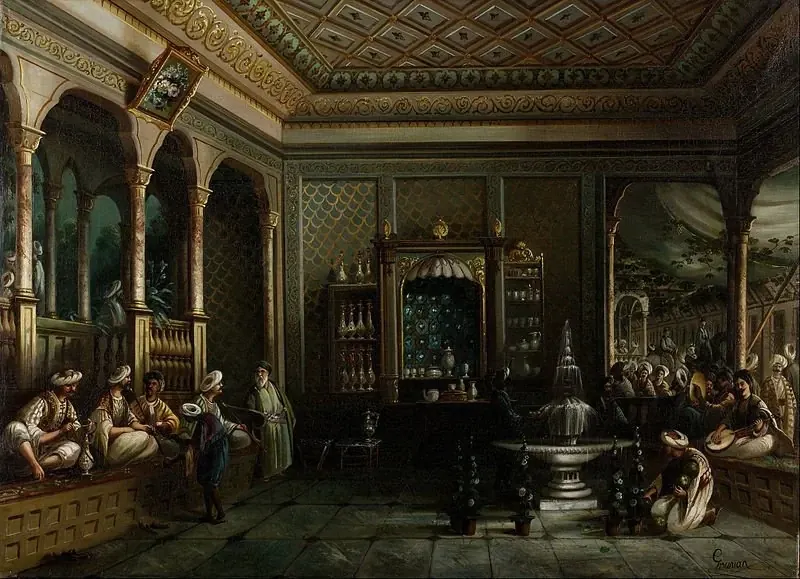
Mu'assel: "honeyed" tobacco
Mu'assel means "honeyed". It is tobacco mixed with molasses, glycerine and flavourings. Some sources link it to early 20th century Egypt, but the exact beginning is unknown.5
Until the late 20th century, hookahs in the Middle East were smoked mostly by older men. From the early 1990s, mild fruit mu'assel attracts the young, and a 2004 study from Syria records that the hookah has become fashionable.56
In 2012 Japan Tobacco bought Egypt's Nakhla, noting almost 100 years of tradition.7
The flavour industry
California's Starbuzz presents itself in its registered trademark as "Starbuzz Tobacco since 2005".8
Jordan's Al Eqbal bought the Al Fakher factory in the Emirates in 2006 for $11 million, automated it and began selling in more than 100 countries.9
Without tobacco: herbal blends and stones
After Russia's 2014 smoking ban, many Moscow venues switch to nicotine-free fruit blends.12
A study in Tobacco Control tested three tobacco-free "herbal" products. One had high levels of lead, chromium, nickel and arsenic, and the smoke contained carcinogens equal to or above those of tobacco products.10
Steam stones are porous stones soaked in glycerine and flavouring. In 2015 the University of Cincinnati found chromium, arsenic and cadmium in simulated smoke, with most of the metals coming from the charcoal.11
On the journey through 14 stations
How we know
- 1Encyclopaedia Iranica, "Ḡalyān"
- 2Encyclopaedia Iranica, "Čopoq"
- 3WHO FCTC Knowledge Hub, "Waterpipe overview"
- 4The National, "Coffee houses of the Middle East"
- 5Wikipedia, "Muʽassel"
- 6Rastam, Maziak i sar. / et al. (2004), BMC Public Health: waterpipe smoking in Syria (PMC514554)
- 7Moodie Davitt Report (2012), "Japan Tobacco to acquire leading Egyptian shisha manufacturer Nakhla"
- 8USPTO via Justia, "STARBUZZ TOBACCO SINCE 2005"
- 9Oxford Business Group (2014), "Al Eqbal Investment Company: Tobacco and cigarettes"
- 10Hammal i sar. / et al., "'Herbal' but potentially hazardous", Tobacco Control 24 (2015)
- 11University of Cincinnati (2015), "Researchers Examine the Dangers Bubbling Up from Hookah Steam Stones"
- 12Bloomberg (2014), "Russia's Tobacco Ban Takes the Buzz Out of Hookah Bars"